
For hardware and software requirements see this topic.
Here, the driver’s documentation is part of its story: knowledge transfer from engineers to field technicians. Clear release notes—enumerating fixed issues, new supported devices, and known limitations—reduce support ticket cycles. A good narrative includes examples of common pitfalls and how to detect and resolve them quickly: checking cabling for serial adapters, ensuring correct virtual COM port settings, or aligning baud rates for legacy integrations. Drivers are code, but the consequences of their success or failure are human. A cashier spared the frustration of reprinting receipts avoids a line that might otherwise grow snakingly long. A store manager, confident in her systems, focuses on inventory and promotions rather than chasing intermittent printer errors. For frontline staff, a driver update can be a small kindness—a reduction in friction that helps them do their jobs with dignity and speed.
But a receipt printer does nothing alone. It is steel and plastic and a carefully wound thermal paper roll until software tells its motors and heating elements to act. That instruction set, the bridge between device and operating system, is the driver—a set of precise instructions that ensure the printer reacts exactly as expected. The filename POS Printer Driver Setup V11.2.0.0.exe represents one iteration of that bridge: a release forged from code, documentation, and user feedback, intended to solve problems and remove friction from the daily flow of commerce. Version numbers are more than bureaucratic placeholders; they are the footprints of progress. The “11” marks a major line of development, a lineage of features and architectural decisions. The subsequent “.2.0.0” signals incremental improvements—bug fixes, added compatibility, refined defaults. This is stable refinement, not a ground-up rewrite. For administrators, seeing that .2 reassures: it’s a release that matters enough to release but not so radical as to upend existing workflows.
The narrative around reliability also includes security. Printers connected to a POS network are potential attack surfaces. A modern driver considers secure communication channels, avoids unsafe buffer handling, and respects principle of least privilege—installing only what’s necessary and leaving open ports shut. In enterprise deployments, IT managers expect vendor guidance on hardening, and the installer may include options to disable remote management or restrict firmware updates to signed packages. Larger organizations treat driver deployment as a logistics problem. They need packages that support Group Policy, MSI wrappers, silent install parameters, and version controls to avoid accidental rollbacks. The Setup EXE ideally ships alongside an MSI or is re-packagable. Documentation must include return codes for automated monitoring, steps for forced removal, and compatibility notes for specific POS applications. POS Printer Driver Setup V11.2.0.0.exe
In the end, the file name is a promise: install this, and the printer will do its job. But within that promise is an entire invisible ecosystem—code, testing, documentation, and support—that collectively keeps the flow of everyday life uninterrupted.
Technicians tasked with deployment hold a different relationship to the driver: they scrutinize logs, maintain images for quick rollbacks, and become stewards of continuity. Their feedback informs future releases. In many ways, the lifecycle of a driver is a conversation between those who build it and those who rely on it in countless micro-encounters with customers. POS Printer Driver Setup V11.2.0.0 did not come into being in isolation. It is the result of cycles: alpha builds tested internally, beta releases rolled out to select stores, telemetry (where available) analyzed for crashes and edge cases, and iterative patches applied. Each release closes certain tickets, opens new ones, and pushes the ecosystem a step forward. The version number becomes a bookmark in the vendor’s changelog and in the memory of IT staff who have wrestled with earlier issues. The Future Encoded in a Filename Even as V11.2.0.0 reaches machines and resolves problems, the next version looms. New POS features—contactless receipts, tighter cloud integrations, firmware over-the-air updates, or advanced barcode formats—will shape future drivers. The filename will change again, but the underlying mission remains: to translate intentions into action, to ensure that the thermal head heats exactly when commanded, that the paper advances the right number of millimeters, and that the printed line is both human-readable and machine-actionable. An Epilogue: Small Things, Big Effects POS Printer Driver Setup V11.2.0.0.exe is more than an installer; it is a hinge upon which dozens of transactions swing each day. It is the result of engineering trade-offs, compatibility testing, and human-centered design decisions. It lives in the mundane space where people pay, receive proof of purchase, and carry on with their day. That quiet function—seemingly trivial—ensures commerce moves forward, receipts issue, and small businesses keep serving communities. Here, the driver’s documentation is part of its
Backward compatibility is paramount. Retailers cannot afford a driver that invalidates older hardware or breaks integration with their POS application. Equally, forward compatibility matters—drivers must gracefully handle new OS security paradigms like stricter driver signing requirements or changes to printer spooler behaviors. Each release is a negotiation between the past and the future. Receipts are terse legal and financial documents. They must render currency symbols correctly, display accented characters for customers’ names, and handle barcode printing for returns or loyalty programs. A driver update can subtly improve how fonts and character tables map to the printer’s thermal head, preventing mangled text or wrong currency symbols. For multinational chains, such improvements reduce customer confusion and ensure regulatory compliance where receipts must include specific fiscal data.
Beyond text, the driver determines how images print—logos, QR codes, promotional artwork. Thermal printers have constraints: limited resolution, monochrome output, and strict byte-level commands to control line feeds and image rasterization. The driver’s conversion routines transform high-level commands from the POS application into efficient binary sequences the printer can execute without delays that might frustrate customers or slow service. An updated driver is often judged not by flashy features but by absence of error. Fewer stalled print jobs, reduced spooler crashes, and fewer calls to tech support—these are the quiet metrics that justify a driver release. When downtime costs real money, reliability becomes a competitive advantage. The Setup program will install diagnostics to help technicians preempt failures: logs that capture failed print sequences, utilities for firmware checks, and test pages that validate alignment and cruising temperatures of the thermal head. Drivers are code, but the consequences of their
It began as a small file name: POS Printer Driver Setup V11.2.0.0.exe. For most, it was simply a string of characters on a support site or a technician’s USB stick — a sterile label promising functionality, compatibility, and the mundane satisfaction of hardware that finally speaks the same language as software. But peel back the layers and that innocuous filename contains a story about interfaces, commerce, and the quiet engineering that keeps modern retail moving. The World That Needs Drivers Imagine a busy corner store at 7:45 a.m. A line snakes past the counter; a barista calls out drinks; a cashier’s hands move in practiced rhythm, scanning items and handing receipts to customers who need quick confirmation of their purchases. The world of point-of-sale (POS) systems is a choreography of small miracles: barcode scanners translating ink onto orders, card terminals completing encrypted conversations with banks, and receipt printers producing the thin strips of paper that close each transaction.
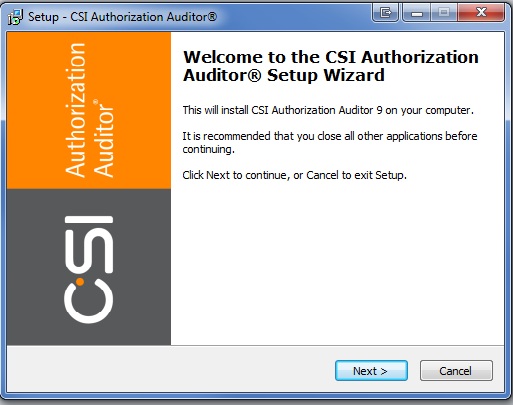
Click next on the welcome screen in order to continue.
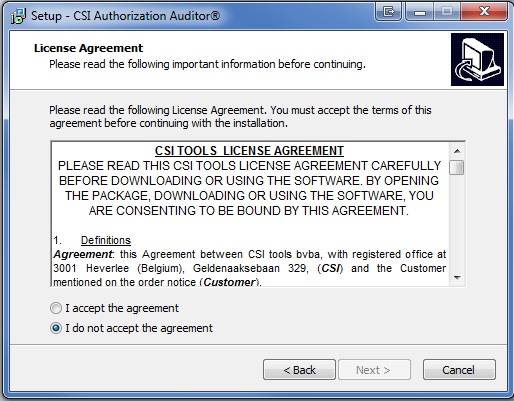
We advise you to read the license agreement before clicking 'I accept the agreement'. Click next to continue.
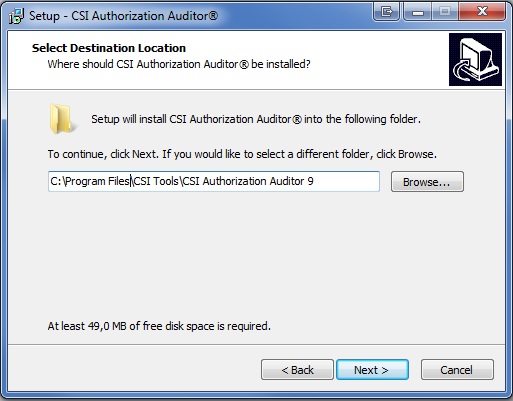
Choose a valid destination folder and click next. If the destination folder does not exist yet, a pop-up dialog asking you whether you want to create the directory will be displayed. Click next to continue.
Note: When installing the Access 2007 or 2010 version of the CSI Authorization Auditor, please make sure that the destination folder is a trusted location.
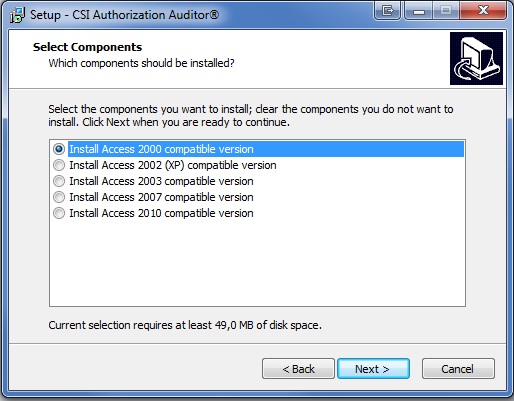
Select which Access-specific version of the CSI Authorization Auditor you wish to install.
Click next to continue.
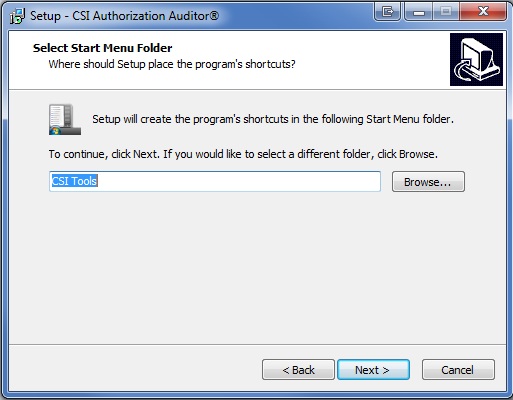
An entry in your start menu will be created. You can define the folder name which will be used.
We recommend that you leave this to the default 'CSI Tools' name. Click next to continue.
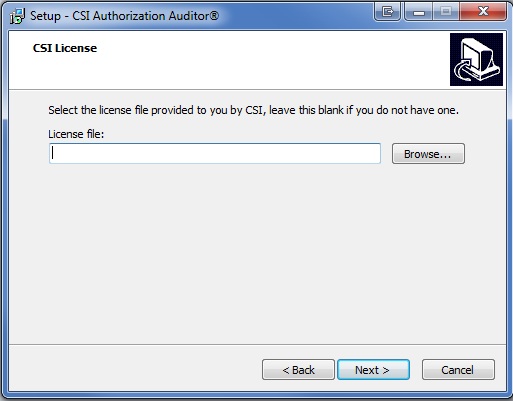
At this step you can browse for your license file which grants you access to your CSI Authorization Auditor. If you do not have this file at installation time, you can skip this step but keep in mind that you will need to link the license file at program startup before CSI Authorization Auditor will be functional.
Click next to continue.
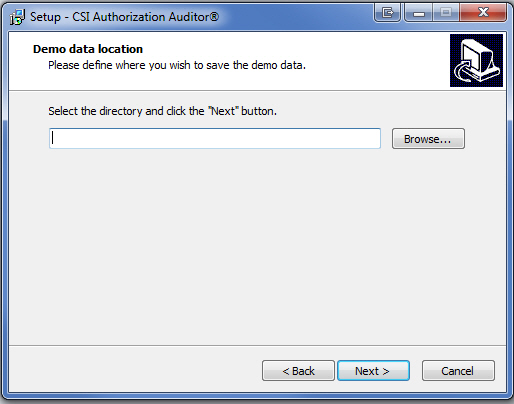
Please indicate the location where you wish to save the demo data which is provided when installing CSI Authorization Auditor.
We recommend to use a user-specific directory such as My Documents. A valid folder must be selected in order for the installation to proceed. Click next to continue.
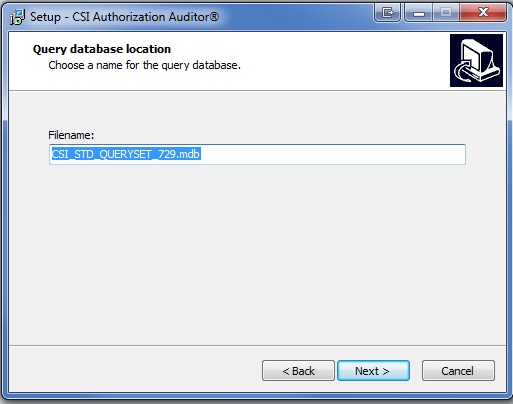
Please choose a name for the query database. Click next to continue.
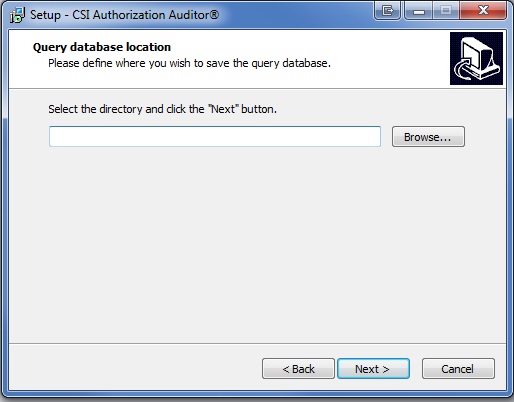
Please indicate the location where you wish to save your query database. We recommend to use a user-specific directory such as My Documents. A valid folder must be selected in order for the installation to proceed. Click next to continue.
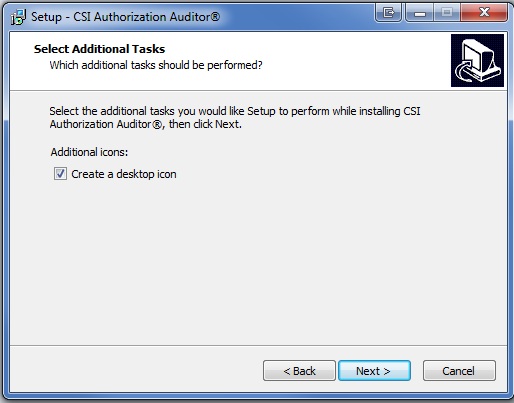
When desired the installation process can place a shortcut to the CSI Authorization Auditor on your desktop. Click next to continue.
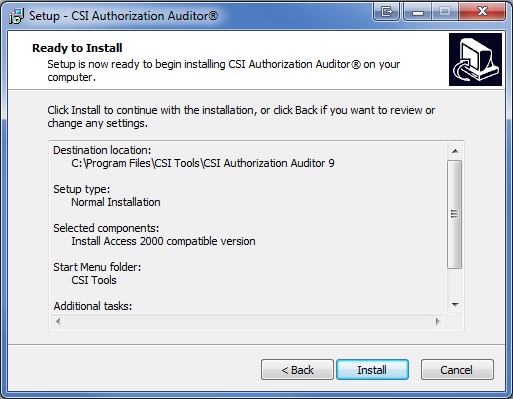
This part of the setup allows you to review the installation settings before the actual installation begins.
Click install to continue.
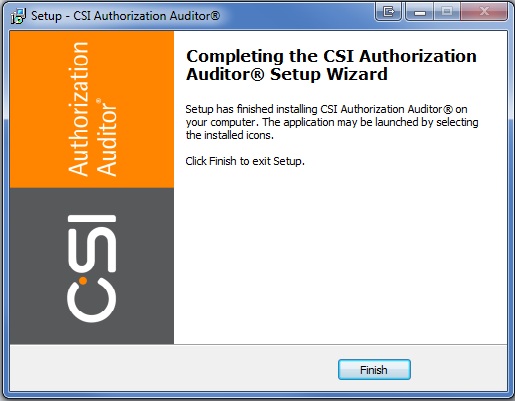
All files have now been copied and installed.
There are two ways to launch the CSI Authorization Auditor:
CSI tools BVBA © 2012 - All Rights Reserved